
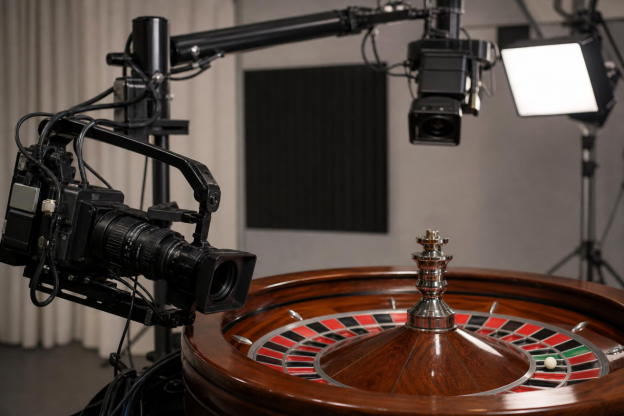
The dealer spins the wheel. A camera follows the ball, then a close-up replay stretches its final bounces across the screen. The sequence borrows from sports television, where a wide shot establishes the action and a tighter angle picks out the detail. Around a live roulette table, that coverage takes several cameras, carefully chosen positions, and software that helps decide what appears next. Following a round through the production reveals how the physical rig, replay system, and result-reading equipment fit together.
Building the Rig Around the Table
For someone viewing live roulette ontario, the first impression comes from the finished broadcast. Behind it sits an installation arranged to capture the dealer, table, wheel, and ball from complementary viewpoints. An Atlantic City project announced in June 2018 specified five cameras, a customized rig, and large mounted screens. Remote participants shared the game with people playing at the physical table. The rig’s screens were designed to show the live table feed alongside promotional messaging.
The installation illustrates how cameras can become part of a working casino floor. Their positions establish the available pictures; shot sequences determine how those pictures reach viewers. Designing the two together gives each angle a place in the round, from the dealer’s movements to the ball settling into a pocket.
Choosing Which Angle Comes Next
A wider view places the dealer and wheel within the room. Closer framing draws attention to the spin, then to the numbered pockets as the ball slows. Each change shifts the viewer’s attention. Multi-camera roulette presentations have used dynamic sequences, close-ups, and slow-motion replays since at least 2013. Automatic camera sequences can vary the presentation between rounds.
The selection happens within the production system. Several cameras may cover the same action, giving the broadcast different pictures to choose from. A wheel view shows the ball’s path, while tighter framing makes its final movement more prominent. The dealer remains part of the wider coverage, linking those details back to the person conducting the game. As the ball approaches the pockets, capture speed becomes especially useful.
Recording Enough Detail for Slow Motion
The ball can change direction several times in a brief passage across the wheel. A high-speed camera records many pictures of that movement, giving a replay more frames to show. One established multi-camera roulette format specifies HD footage at 200 frames per second. A format introduced in February 2025 describes 4K capture of each round’s outcome, close-up angles, and slow-motion replays.
Frame rate and resolution describe different qualities. The first counts pictures captured each second; the second describes the image’s pixel dimensions. Playing footage below its capture rate spreads the movement over more time. U.S. Patent 9,483,902, covering immersive roulette, describes software receiving footage from several cameras, finding the ball, and tracking its movement. As the ball approaches the pocket-drop stage, the design calls for slow-motion images. It also describes selecting cameras whose views cover the moving ball.
Reading the Result From the Wheel
When the ball settles, connected equipment needs the winning number in a form it can process. Wheel sensors and dedicated camera systems offer ways to obtain it. One commercially documented wheel has four sensors inside its rim. They recognize the winning number and send live data to table displays and analysis software. Another documented system uses a camera to read results from compatible wheels.
A display system can receive that information through built-in sensors, camera detection, or manual keypad entry, depending on its setup. This data connection accompanies the pictures viewers see, allowing the physical result to appear on connected displays. The activity carries financial risk. In Ontario, where operators such as ToonieBet ON are regulated by the Alcohol and Gaming Commission of Ontario and operate under an agreement with iGaming Ontario, participation is restricted to adults aged 19 and older. Anyone choosing to gamble should set affordable spending and time limits, take breaks, and seek support if gambling becomes difficult to control.
Lighting, Networks, and a Record of the Round
Even a well-placed camera needs suitable light and a reliable connection. In one electronic-table installation, engineers tested compact camera sensors under demanding lighting conditions, added custom infrared illumination, and upgraded the network to carry high-frame-rate video.
Recording brings another responsibility. In the U.S., for example, the Michigan Gaming Control Board’s live-game framework requires continuous, unobstructed surveillance with enough detail to review procedures and reconstruct games. Recordings must generally remain available for at least 90 days. Material connected with investigations is kept until those investigations finish.
Those requirements extend the work beyond the pictures selected for the screen. A round must also leave a usable record. Behind the brief sequence from dealer to wheel to replay sits an installation built to capture movement clearly, communicate the result, and preserve what happened.