
Goodbye to the Scout’s Eye
Let’s be real for a second about how sports video games used to operate. A developer in a cubicle would watch a few highlight reels, read a scouting report, and arbitrarily decide how fast a digital wide receiver should run. We relied entirely on subjective narrative bias to build the virtual gridiron. The landscape today looks absolutely nothing like that era. We are no longer playing a game; we are interacting with a highly complex mathematical ecosystem.
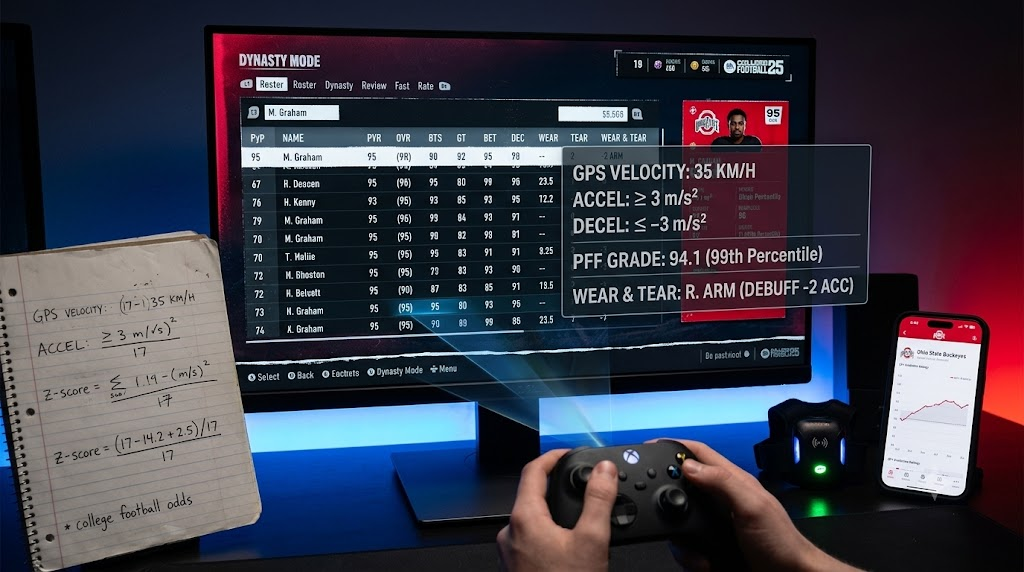
Physical attributes in this modern engine are not guessed. They are extracted directly from global positioning system (GPS) velocity tracking and wearable biometric technology. A highly touted first-round draft prospect and an unheralded walk-on are judged by the exact same physical physics models. If a lesser-known player registers a peak in-game velocity of 34 km/h on his real-world shoulder pad tracker, the Frostbite engine’s algorithms assign a corresponding 99-scale speed rating. Your favorite team’s digital speed is simply a reflection of objective, undeniable physiological reality.
The Spreadsheet in the Trenches
Look closer at the line of scrimmage, and the data dependency becomes even more obsessive. Raw speed is easy to code. Football IQ is not. To simulate authentic trench behavior, the engine requires massive data ingestion. Developers now rely on Pro Football Focus (PFF) grades to evaluate the granular details of every single play. A right tackle might perfectly execute a reach block on a defensive end, but if the running back fumbles the ball immediately, traditional box-score statistics ignore the lineman’s effort entirely. PFF’s play-by-play grading captures that localized execution. Tape never lies.
This plus-minus grading system ensures that virtual counterparts of elite trench players behave with the technical proficiency their real-world tape actually demonstrates. The software translates a +1.5 PFF grade into increased run-blocking footwork code. You are feeling the weight of thousands of human-logged data points every time you press the sprint button behind a pulling guard.
Mid-season algorithmic adjustments push this reality even further. Breakout real-world performances instantly alter the competitive meta of the game. When Iowa’s Kaleb Johnson exploded on the actual field in October, dedicated “Ratings Adjusters” fed his analytics into the machine, resulting in a massive +13 rating increase in the software. Millions of gamers had their online strategies upended overnight because a 21-year-old in Iowa ran the ball well on a Saturday afternoon.
Vegas in Your Living Room
Hardcore franchise players have evolved alongside the software. They do not just blindly pick a team based on uniform colors anymore; they operate like Wall Street quants looking for market inefficiencies. The same data streams that drive multi-billion dollar sportsbooks are now utilized by gamers to optimize their digital strategies over a 30-year Dynasty run.
Savvy users study Bill Connelly’s SP+ ratings—an opponent- and tempo-adjusted measure of college football efficiency—to forecast long-term programmatic success. These digital general managers calculate expected value just like Daily Fantasy Sports (DFS) professionals. Many of them are actually scanning real-world college football odds to identify which underdog programs are mathematically primed for a breakout season. You can take those insights straight into the game, leveraging baseline overall ratings and defensive AI logic to build powerhouse programs out of overlooked schools. The line between sports betting analysis and virtual roster construction has completely evaporated.
Simulating Fractured Bones and Fractured Egos
The human body is not a machine that can absorb endless punishment, and the code finally respects that reality. EA’s proprietary “CampusIQ” system fundamentally destroys the old strategy of handing the ball to your star running back 45 times a game. The new “Wear & Tear” system mathematically simulates the cumulative physiological toll of a sixty-minute football game.
Every single hit is processed through a physics engine that calculates the momentum, angle, and mass of the collision. A high-impact kinetic vector targeting the lower body will spike degradation values in a player’s leg health parameters. You will visibly see your star athlete lose his burst and alter his gait by the fourth quarter. Extreme heat accelerates stamina depletion, while freezing temperatures increase the severity of contact-based stiffness. The game forces you to utilize analytics-driven load management, effectively turning you into a sports scientist on the sideline.
Frankly, the psychological simulation is just as punishing. When you take a visiting team into a hostile environment like Penn State’s Beaver Stadium, the game introduces algorithmic sensory disruptions. Your screen shakes; your play art moves; your pre-play receiver icons vanish. A senior quarterback with high composure ratings will mathematically resist these visual debuffs, but an untested true freshman will buckle under the algorithmic pressure.
The Transfer Portal is a Brutal Calculator
The courtroom shattered the traditional amateurism model of college athletics, and Dynasty Mode had to rewrite its entire economic foundation to match. Roster loyalty is a dead concept. You are now navigating a highly volatile, deregulated labor market characterized by Name, Image, and Likeness (NIL) demands and the relentless threat of the transfer portal.
Virtual athletes now possess specific, weighted motivations—ranging from immediate playing time to brand exposure. Any attempt to hoard elite 5-star talent at a single position is mathematically penalized by the simulation’s attrition algorithms. If you recruit a highly-rated freshman quarterback but bench him behind a veteran starter, the game’s logic dictates a massive probability that the freshman will enter the transfer portal at the end of the season.
The catch? Gamers are discovering that the most efficient way to build a dynasty is to evaluate 3-star “gem” recruits. These players offer high developmental upside with a significantly lower mathematical probability of transferring. You have to balance the ego of a digital athlete against the stability of your programmatic salary cap.
The AI That Learns Your Bad Habits
Artificial intelligence is rapidly closing the gap between human intuition and programmed response. Historically, sports game AI relied on rigid decision trees and simplistic logic loops. You could find a money play—like a specific Run-Pass Option (RPO)—and spam it against the computer until the clock ran out.
Deep reinforcement learning has killed the money play. The CPU now dynamically adapts to your specific spatio-temporal tendencies. If you repeatedly abuse a specific offensive concept, the neural network recognizes your pattern and adjusts its linebackers’ run-fit algorithms in real-time to neutralize you. The defense actually learns.
The software is also watching you. Telemetry data collected during your gameplay is constantly fed into classification models to predict your performance and identify your frustration levels. The engine knows when your pass completion percentage plummets and your controller inputs become erratic. We like to think we are outsmarting a static piece of code, but the reality is much colder. The virtual gridiron is a living algorithm, and right now, it is studying your tendencies just as closely as you are studying its mechanics.